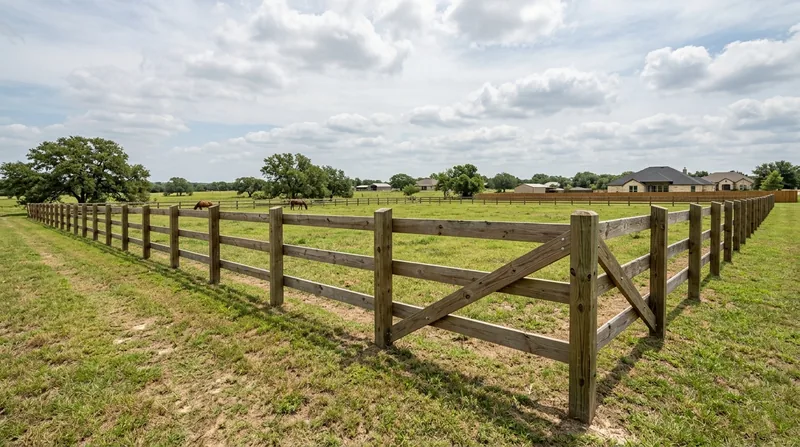




Farm fence installation in San Antonio requires more than standard residential fencing know-how. The Hill Country and South Texas acreage that surrounds San Antonio presents unique challenges: expansive clay soil that heaves with wet-and-dry cycles, long sight lines that demand straight posts and braced corners, and the need for gates sized to handle trailers, equipment, and livestock. Whether you're securing pasture for horses, containing cattle across Medina or Wilson County, or defining property lines on multi-acre tracts in Bandera or Comal County, the fence must stand under Texas heat and heavy rains without racking or leaning. San Antonio Fence Company has installed and repaired ranch and farm fencing across South Texas since 2015, and we understand the terrain, the soil, and the specific demands of rural property.
Why Farm & Ranch Fencing Matters in San Antonio Hill Country and Beyond
A residential fence protects privacy and defines a yard. A farm or ranch fence contains livestock, secures equipment, and marks property boundaries across open land where failures are visible from the road and can cost you animals or liability. Posts must be set deep and straight, braced at corners to resist the lateral forces of wind and animal pressure, and built to last through seasons of freeze-thaw and the relentless Texas sun. The soil in this region is the defining challenge: clay-based and prone to heave, which pushes posts out of plumb and racks fence lines. Proper post depth, concrete setting, and corner bracing are not optional.
- We set posts in concrete below the frost line, not simply tamped, to resist seasonal heave and movement.
- We brace corners and gate openings with diagonal or X-bracing to distribute lateral loads from wind and livestock pressure.
- We work from your existing survey or the line you identify, installing on the boundary you specify.
- We call for a Texas 811 utility locate before every post hole to avoid buried lines.
- We size gates for trailers, ATVs, and equipment, with proper hinges and latches rated for rural use.
The result is a fence that holds its line year after year, even on acreage where a leaning post or sagging gate becomes a safety issue and a costly repair.
Key info: Bandera, Medina, and Comal County properties often sit on land that shifts with seasonal moisture. We set every post in concrete and brace corners as standard practice, not an upgrade. This prevents the leaning fences you see throughout Hill Country on properties where posts were only tamped into clay soil.
For more detail on how we approach fencing challenges in rural settings, see our guide to fence post repair and replacement, where heave and settling are the most common failure modes we address.
How We Install Farm & Ranch Fencing Across South Texas
Farm fencing is built in stages, each one critical to the final line and the fence's ability to hold. We start with a site walk to understand the terrain, identify utilities, confirm your property line, and discuss your goals: are you containing horses, cattle, or both? Do you need gates for equipment access? What materials make sense for your budget and the land? Then we move to layout and post setting, the foundation of every strong fence.
- We call for a Texas 811 utility locate and mark the property line or fence path you've identified.
- We lay out post locations, accounting for terrain, gate openings, and corner bracing requirements.
- We dig holes to proper depth, set posts in concrete, and brace them plumb and square.
- We install rails, wire, or pipe, bracing corners and gate frames with diagonal members to resist wind and animal pressure.
- We hang gates, set hinges and latches, and test the swing and latch for smooth operation.
- We walk the completed fence with you and address any final adjustments.
This process takes longer than residential fencing because the stakes are higher and the forces involved are greater. A horse fence or cattle fence that fails is not a cosmetic problem; it's a liability and a loss.
Example: A 40-acre property in Boerne with a 2,000-foot perimeter fence for horses, including two equipment gates and corner bracing, typically requires 3 to 5 days depending on terrain and soil conditions. We set posts every 6 feet for rail or no-climb fencing, brace corners with 4x4 diagonal members, and hang gates on heavy-duty hinges rated for the load.
Learn more about our approach to gate installation and repair for rural properties.
Farm & Ranch Fencing Methods and Materials for South Texas
| Approach | Description | Best For |
|---|---|---|
| Split Rail | Pressure-treated or cedar rails notched into posts, typically 3 or 4 rails high. Classic appearance, open sight line. | Property definition, decorative boundaries, upscale ranch aesthetic. |
| No-Climb Horse Fence | Rigid wire mesh welded to posts, typically 4 feet high with 2x4 or 2x6 lumber frame. Prevents horses from hooking hooves. | Horse pastures, equestrian facilities, containment where safety is paramount. |
| Pipe or Tube Fencing | Steel pipe or tube, galvanized or powder-coated, bolted or welded to steel posts. Extremely durable and clean looking. | High-end ranch, livestock containment, long-span gates, areas requiring minimal maintenance. |
| Barbed or Field Wire | Galvanized wire strung between posts, typically 4 to 6 strands. Economical, effective for cattle and deer control. | Large acreage, cattle ranches, perimeter fencing where cost efficiency matters. |
| Combination (Rail + Wire) | Split or pipe rails topped with wire or mesh, combining structural strength with containment. | Mixed-use ranches, horses and cattle, properties requiring both aesthetics and function. |
Each method has a cost profile and a maintenance schedule. Split rail and pipe look cleaner and require less upkeep; wire is the most economical for large acreage but needs periodic inspection for sagging or breaks. We help you choose based on your animals, your budget, and how much time you want to spend on maintenance.
Farm & Ranch Fencing Cost in San Antonio: What to Expect
Farm fence installation pricing starts at $12 per linear foot for basic wire or split rail fencing on straightforward terrain. That figure assumes level ground, accessible post locations, and no major obstacles. Real-world costs move up based on several factors: terrain that requires stepped or racked installation on slopes, soil conditions that make digging harder, the need for braced corners and multiple gates, materials (pipe and steel cost more than wood or wire), and the distance from our base in San Antonio to your property.
A 2,000-foot perimeter fence with two gates, corners braced, and posts set in concrete typically runs $24,000 to $32,000 depending on material choice and terrain. A smaller property with 500 feet of split rail on level ground might be $6,000 to $8,000. The only way to know your specific cost is to have us walk the land, measure the run, understand your soil and slope, and provide a written estimate.
We always recommend getting 2 or 3 estimates before you commit. This gives you confidence in the price and lets you compare how different contractors approach the job. Our estimate is free and comes with no obligation to book. Call us at (830) 266-4023 or visit our pricing overview for more detail on cost factors and material choices.
Key info: Acreage in Bandera, Medina, Wilson, and Comal counties often has clay soil and uneven terrain. These factors increase post-setting costs because we must dig deeper to avoid heave and may need to step or rack the fence on slopes. Budget for soil conditions when you get estimates, not just the linear footage.
Farm & Ranch Fencing Near Me: What San Antonio Homeowners Should Know Before Hiring
When you call a fence contractor for acreage or ranch work, you're looking for someone who understands rural property, knows how to work with difficult soil, and has the equipment and crew to finish the job in reasonable time. Here's what to ask and what to verify before you sign a contract.
- Confirm the contractor is fully insured and bonded, and ask to see a certificate of insurance listing your property as an additional insured during the work.
- Ask whether they call for a Texas 811 utility locate before digging, and whether that cost is included in the estimate or billed separately.
- Get a written estimate that breaks down material costs, labor, and any travel or site-prep fees; verbal estimates are too easy to misremember.
- Ask for references from recent ranch or acreage jobs in your county or nearby, and call at least two to ask about soil conditions and how the fence has held up.
- If your property is in an HOA or deed-restricted community, confirm that the fence design and material comply with your restrictions before work starts.
- Discuss timeline: how long the job will take, whether work happens in one continuous push or over multiple days, and when gates will be operational.
San Antonio Fence Company is fully insured and bonded, an AFA member installer (American Fence Association), and has worked across South Texas since 2015. We're happy to provide references and to walk your property with you before any estimate. Call us at (830) 266-4023 or request a free estimate online. We respond within 24 hours and work across San Antonio, New Braunfels, Boerne, Seguin, and the surrounding counties.
Farm & Ranch Fencing in San Antonio: Pricing Guide
| Service | Price | Details |
|---|---|---|
| Split Rail Fencing | Starting at $12/ft | Pressure-treated or cedar rails set in concrete posts. Cost increases with rail count, wood species, and terrain slope. |
| No-Climb Horse Fence | Starting at $16/ft | Rigid wire mesh welded to lumber frame, 4 feet high. Price reflects material and labor for safe equestrian containment. |
| Pipe or Steel Tube Fencing | Starting at $18/ft | Galvanized or powder-coated steel, bolted or welded to steel posts. Premium durability and low maintenance justify higher cost. |
| Barbed or Field Wire | Starting at $8/ft | Galvanized wire strands on wood posts. Most economical option for large acreage and cattle containment. |
| Gates and Bracing | On estimate | Equipment gates, corner bracing, and special terrain work require site assessment. Typically $2,000 to $5,000 per gate. |
| Free Estimate | No charge | Response within 24 hours. We measure the property, assess soil and terrain, and provide a detailed written quote. |
Indicative pricing, free personalized estimate within 24h at (830) 266-4023.


